Saturday, August 3, 2013

#36 Locked down


Maureen and Kim "locked down" to a bulldozer
at the site of the Caltrans construction site
for the Willits Bypass, July 30 (Photo by Ree Slocum)
“There's a time when the operation of the machine becomes so odious—makes you so sick at heart—that you can't take part. You can't even passively take part. And you've got to put your bodies upon the gears and upon the wheels, upon the levers, upon all the apparatus, and you've got to make it stop. And you've got to indicate to the people who run it, to the people who own it that unless you're free, the machine will be prevented from working at all.”
― Mario Savio

          As I was locked down to this big machine for 7 hours on July 30th, I thought about the speech that Mario Savio made in 1964 (you can see it here on YouTube). He and others in the Free Speech Movement were protesting the University of California’s ban on students' providing information tables in the university plaza at U.C. Berkeley.
         I stood there and kept thinking, “Sometimes you’ve got to put your bodies upon the gears…and make it stop.” I felt I had to do that, even for one day to keep this huge bulldozer from ripping down another hillside down to create “fill,” a pile of dirt for the southern exchange of the Willits bypass. Where there used to be forests on either side of the hill will be huge cement offramps, and if the bypass supporters have their way, a whole lot of fast food restaurants. Progress!
          So at 5 am on Tuesday morning, Maureen and I tucked our hands into a metal pipe about 6 inches wide and 2 feet long, with small chains around our wrists and a metal clasp at the end, which we clipped onto a pin inside the metal pipe. Prior to that, I’d inserted my hand through a metal handle on the bulldozer, so that no one could then pull my arm out. We were “locked down” to the machine.


Maureen and Kim with arms in metal pipe
 (Photo by Ree Slocum)
           I did not know Maureen very much at all before this event. We’d met in the Save Our Little Lake Valley meetings. She is a wonderful free spirit from Arcata, age 66, dedicated to preserving the precious forests we have, like Richardson Grove further north on Highway 101 and also under attack. Being locked down with Maureen for what would be seven hours gave us a long opportunity to share stories about our lives. Soon, we were mulling over our experiences with Caltrans workers, with the press, with supporters who walked up and drove by, waving their hands or honking, and with those who objected to our actions, those yelling, “F#g welfare hippies!”
          When the dozer driver arrived at 6 am, he was understandably and vehemently angry. “You f&g environmentalists! That’s my work you’re taking away from me!” he screamed.
          We are non-violent and practice not responding with anger or sarcasm. “I’m sorry to affect your day's wages," I said, "but you’ll have many years of work here destroying this valley that will never be the same—”
          “Yeah, you’ll be sorry if I start up this machine and plow you under. Your family will be sorry! Your parents will be sorry.”
          Fortunately, he did not take his anger out on us in that way. My heart was pounding.  
          The next two construction workers who arrived also screamed at us. One claimed, “Casey over there has four kids to feed. You’re taking the food out of their mouths.”
         
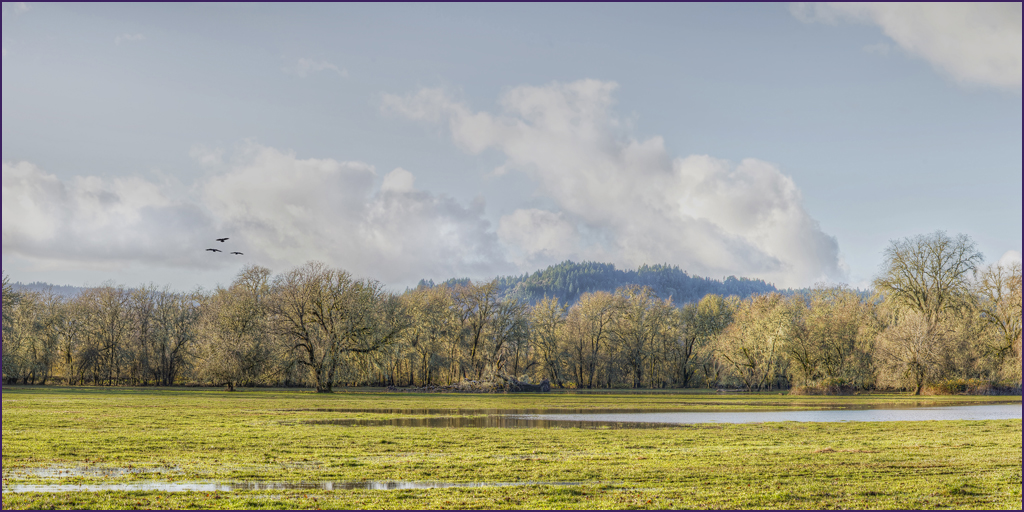
Little Lake Valley Wetland (photo, Steve Eberhard)
    “You’re taking 2000 acres of farmland out of this valley.” But neither Maureen nor I wanted to interact much with them in that situation. It’s not like either side is going to convince the other that we are right in such a tension-filled interaction.
          
So why pull this action? It's a rare opportunity to bring dramatic attention to our cause in even a small way. It's an opportunity to stop the odious destruction reaped by the big machines for one small day in the long, long process of building an unnecessary $300 million dollar cement highway that will destroy so much precious land and spend so much precious money (as my previous blogs on the topic have pointed out).
Wetland being drained with 85' deep plastic  "wicks"
(Photo, Steve Eberhard)
           Sometimes you just have to say, “Stop! I won’t put up with it anymore! We will not let you proceed without demonstrating our contempt for the destruction that so lacks consciousness about the value of our environment”—even if that makes me merely a friggin’ environmentalist.
         People once believed the earth was flat, after all. 
          I believe that the construction of the Willits Bypass is contributing to global climate change, and the destruction of a precious wetland that will never be repaired by the mitigation that Caltrans promises.
          I believe that Caltrans manipulated data regarding the need for a 4-lane bypass in order to gain public approval of their overbuilt behemoth.
          I believe Caltrans has refused to listen to the viable alternative plans for an alternate route that the Willits community created and desperately wants. Why have they refused? Because Caltrans wants a regional route to fulfill their own corporate purposes, so what Willits really wants and needs is not important.
          I believe Caltrans has been and will continue to be sorely mismanaged, utilizing fraud and strong arming techniques (after all, they have the paramilitary force of the California Highway Patrol to help them build their highway) to get their way. They have the guns and the tanks, they have the power to get what they want. If they think we are so few in number, why are they so angry with us as we try to remain non-violent with them?
         I’ve had lots of time to think about these contradictions while I've been not only locked down to that machine but also locked down in jail for two more days.
          In upcoming blogs, I’ll continue the story of what happened with supporters that day, including Steve Keyes who also got arrested on Tuesday, what happened with our police negotiations, and what happened when we went off to the county jail in Ukiah. We didn’t get out until Thursday morning, and much transpired in the meantime that has provided rich food for thought--and for action.

Wednesday, June 26, 2013

#35 We'll Give Up When We See the Whites of Their Eyes

Crane in moonlight (Photo: Ree Slocum)
        "The trees are gone. It's over," the CHP officer told me as he was forcing me and the other protestors off the dying wetland where we were trespassing on the huge swath of former wetlands that Caltrans contractors are draining of its water for the Willits bypass.
        I don't believe it's over yet. Neither do the rest of us who pretend to understand what's at stake for the future of the Little Lake Valley watershed, the quality of life for Willits residents, and the economics of a waste of money.

Will Parrish on Wickdrain Driver (Photo: Steve Everhard)
        Certainly, Will Parrish also intends for this struggle not to be over yet. He has been 50 feet up a wickdrain driver for the last six days, continuing to protest what these machines are doing, pushing 55,000 plastic tubes into the wetlands to drain it of water. (See video.)
        Right now, the CHP are refusing to let supporters get water and food to Will.
Photo: Ree Slocum
Several people were arrested on Saturday night in the act of bringing supplies. One police officer cut the rope to the bucket that Will was going to haul up, and then proceeded to arrest him.

This brief KGO TV report on Monday, June 24th, explains the situation.

This protest and set of arrests in the last in a series. Here is a YouTube video of the protest on May 13th, where one protester "locked down" to a piece of equipment.

On May 19th, five others were arrested as part of a "Hands Around the Wetlands" protest at the wickdraining site, the protest I took part in and where I was told to give up, now that 2000 trees have been sacrificed to the proposed cement river replacing the wetlands (see this YouTube film of it). This KGO report video shows both that action and the recent court battle was produced by KGO on Friday, June 21.

The court battle involved the convergence in a U.S. District Court in San Francisco on Friday, June 21st, of the lawyers making a case against the Willits bypass, the defendants--the U.S. Army Corps of Engineers and Caltrans--and 30 Willits residents (including me). The appeal was heard by Judge Jeff White in a hugely complex case that (to over simplify) brought charges against the Army Corps and Caltrans for failure to create adequate measures for the mitigation of the environmental damage they will do to Little Lake Valley. We have now to wait for the judge's opinion.

We aren't ready to say that this 4 lane bypass is the best way to resolve a 10 (20 minutes in holiday traffic) delay on the road....
Hands Around the Wickdrained Wetlands (Photo: Steve Eberhard)


Thursday, May 30, 2013

#34 Follow the Money

           The struggles continue and will continue--even if we have to end up painting "$300 million wasted" onto the cement viaduct.

Kim & Sata at Memorial Day Demonstration, photo by Steve Eberhard
           Check out this 5 minute KGO San Francisco news report  (May 9) that reinforces how unnecessary the Bypass is when you see the actual video footage of cars leaving Willits at the north end of town on Highway 101: long stretches of no cars or 1 to 2, with a “glut” of 3 to 4 at a time every now and then. Granted, on the days before and after major summer holidays, like Memorial Day and the Fourth of July, traffic piles up for a few hours. But a 4-lane bypass that can carry 40,000 cars a day is unnecessary for even that problem when an alternate truck route—already designed by community members years ago—would take care of those heavy traffic days.     
Bob Chevalier locked down to equipment for drilling wetlands,
photo by Steve Eberhard
         By the way, that report says the Bypass will cost $210 million, but we have seen other numbers, and we also know that cost over runs are famous. In fact, Caltrans was just in the radio news this morning on the California Report (the first minute of this link) that Governor Brown finds the "insular culture" of Caltrans that is "not responsive" to taxpayers and requires "top to bottom" investigation. (Also see this report on the review for the full written article.)
     Work on the Bypass continues, despite ongoing tree sits, folks locking themselves to equipment, and demonstrations by the roadway.
Tree Sitter Red Tail Hawk, photo by Steve Eberhard
      With the major forests in the way of the Bypass now pretty much destroyed, Caltrans is beginning to drill their 55,000 holes 80 feet deep into the wetlands of Little Lake Valley in order to pump out the water. Their mitigation plan says they will recreate an equivalent wetland elsewhere. Right!
          One of the contractors hired by Caltrans to help build the Bypass had an agreement not to use city streets so that the 114,000 dump trucks hauling fill in and other materials would not destroy Willits streets. Instead, the contractor is supposed to build a separate “haul road.” However, we just learned that the contractor said it is too expensive to build a separate road, so Caltrans has violated another agreement—and we’re only four months into their construction, with six years to go.
 
Drill rig set up to begin boring test holes. Photo courtesy of Steve Eberhard.
           
          But we have to remember: This Bypass is not for Willits. It’s for anyone traveling up and down Highway 101 that doesn’t want to stop in Willits.
                Most scams and scandals are tied to money, power, or fear of harm in some way. I’m learning that the imposition of the Willits Caltrans Bypass is all about the money: reaping the benefits of the $300 million dollars that regional and local politicians, labor representatives, and citizens plan to get from the state and federal government. The mantra that the Bypass will help traffic congestion is the smokescreen for the real motive: money and jobs.
            Why is Caltrans so fixated on 4 lanes? Once they convince everyone that 4 lanes are necessary, then they can apply for the federal funds, as Caltrans spokesperson Phil Frisbie made clear to me in an interview.
           Ellen Drell and her husband David Drell have been two of the main combatants against the Bypass through their work at the Willits Environmental Center. (Check out an article that Ellen wrote a year ago.) Ellen gave a talk at the Willits Library on May 13th about the complex history of the Willits Bypass struggle dating back to 1962. At various points over the last five decades, with no funds in sight, the Bypass plans were shelved. When the economy melted down in 2008, so did state funding for unnecessary transportation problems. So in September 2010 when Caltrans again sought Bypass funds from the state, they were denied. The Bypass was considered “dead,” even by Bypass supporters No wonder everyone thought it would never happen.
           Apparently, however, when federal stimulus money became available with the Recovery act, Congressman Mike Thompson (5th District) sought to please his labor constituents with the pork in the Bypass barrel and pursued the Bypass. The Bypass was back on the table, the money was flowing, and the chainsaws started ripping into the forests immediately.
            The corruption at the heart of the Bypass is the way that all the “deciders” were essentially duped by Caltrans into believing that we need 4 lanes, based on a rather obscure traffic flow designation called Level of Service (LOS).  Traffic engineers rate traffic flow from A (very little traffic and fast flow) to F (bumper to bumper jams). They recommend that highways be designed to create at least a middle level of flow, C, over the next 20 years. Caltrans is convinced that a two lane bypass would create an LO.S D, which is unacceptable
         Here is where you can find a Caltrans webcam on mile north of Willits.
image from camera Our traffic problem requiring the Bypass!
            If you look at the actual footage of traffic leaving Willits at the north end of town, or you’ve driven it, you’d probably declare that it’s already LOS B or even A since there is a constant flow north with so little traffic (except in the peak hours of vacation revelers flowing north). This rather complex calculation relates back to having a huge bureaucracy focused on an antequated model of transportation design, out of touch with today’s environmental realities, and looking out for its own best interests rather than what Willits needs or wants.
         If you think something is wrong here, please contact Governor Brown and tell him to stop the Bypass. It’s a huge waste of money.


Thursday, May 9, 2013

Blog #33 The Bypass Is Ruining My Day--and Our Valley

            Anyone remember that faux-’50s cartoon of a woman with hand to forehead, complaining, “A nuclear bomb? That ruins my day!” That’s the Bypass for me, but it’s not funny. For those of us working to stop the Bypass, it threatens to take over whatever peace of mind we’ve established, not to mention our schedules as we squeeze in as many protests, meetings, letter writing, and other actions as possible.
           One great new tool for our protest is this video. Got 11 minutes? Here’s a great little video that someone put together that explains the whole Bypass Drama: “How CalTrans Sold the Willits Bypass” on YouTube. Good visuals and clear explanations!
Protest-1-2.jpgProtest-1-22.jpg            Local actions revved up with Earth Week. On April 23 two elderly Willits women, aged 78, were arrested at the Caltrans office for refusing to leave when their concerns were not adequately addressed. A crowd cheered them as they went off to jail.(Photos by Steve Eberhard)              

 On April 28th, Save Our Little Lake Valley hosted the first educational forum in a series.
The focus was “Wetlands, Wells, and Wickdrains,” with scientific information provided on the impact of how the bypass might affect this precious resource. “Wickdrains” refers to the 55,000 holes 86 feet deep that will be dug into our wetlands to pump out the water. Our generally well-respected sheriff, Tom Allman, was the forum moderator. He lives in the valley not far from where the viaduct will pass by his land, so perhaps he was hoping to have his own concerns addressed.
Audience at the Grange on a Sunday afternoon.
John Ford is second from left in front.


He also brought along John Ford, a venerable rancher neighbor on whose former land the Bypass will cross. Ford, respected in the valley by “tree huggers” and conservatives alike, said that he found Caltrans “dysfunctional” and was wary of what they will do to the valley. Indeed.

Yes, talk about dysfunctional, read the news about the 2300 “banned bolts” that Caltrans installed in the new Bay Bridge (SF Chronicle article, May 9, 2013). Does that make you a little uneasy about driving over the bridge? It will cost them $10 million to repair it (KQED, May 8). But that’s another story. 
And such a dismal record still doesn’t stop The Machine from its well-armed (with a little help from their friends the CHP) and well-financed assault (to the tune of $300 million plus) on Little Lake Valley. Let’s hope their viaduct  won’t fall into the wetlands and cost an extra $20 million to repair, huh?
            No, we are still hoping to stop the Bypass before it gets to that dismal stage, with many plans ahead.
            We are planning another forum, the next one on the economics of the Bypass and how it will affect local businesses in the long run, not to mention the current impact. Many supporters of the Bypass claim it is providing jobs, and so they will do whatever they have to in order to make good money. The forum will ask what ethical considerations should be involved in allowing labor to make good money in the short term at the expense of long-term environmental concerns. (The human species can be so limited, it’s infuriating!)
            Another development was that the local band of Pomo Indians on the Sherwood Rancheria got involved recently with examining the impact of the Bypass construction was disturbing cultural heritage sites. The Ukiah Daily Journal (May 7) reportedby the Tribal Chairman, Michael Fitzgerral:
            "The tribe is aware of, and gravely concerned about, sacred and village sites that, while known to the tribe, have not been properly identified by archaeologists working on this project," says Fitzgerral in a press release. "The project site consists of one of the largest conglomerations of cultural sites, including burials, work areas, village sites, cooking areas, and all the places that one might need to survive and live. The project will cut into these important sacred places and cause irreparable harm if CalTrans proceeds unilaterally with construction prior to the proper analysis of the impact and a mitigation plan of the project on tribal cultural resources in consultation with the tribe."
            Finally, the last two tree sitters flew their coops, but another one has taken to a tree, which you can see on the SOLLV site. We keep hoping for more brave folks to put some kind of dent in the progress of “progress” (as some see the Bypass).
            Beyond the local, Willits residents against the Bypass made two trips
across the state to voice our concerns. One trip took 19 Willits citizens to Sacramento on May 2-3 for several meetings with representatives of Governor Brown and state agencies, including the Department of Fish and Wildlife, the Policy Director for Lt. Governor Gavin Newsom, and the Governor’s Office of Planning and Research. We have yet to see how those meetings will pan out for state officials taking into consideration the eloquent voices of local activists.
Protest at State Capitol, photo by Steve Eberhard, Willits News
            Another contingent went to LA on May 6th-7th to speak at a meeting of the California Transportation Commission where we hoped to make the case that the remaining funds for the Bypass should not be awarded since they have not been fulfilling their mitigation efforts as promised. However, just on Thursday, we learned that the $30.9 million were awarded afterall. The issues are so complex that I won’t go into the details here, but the link to the Ukiah Daily Journal above gives more details.
            Meanwhile, Caltrans is ready to begin drilling its test pilings, puncturing the heart of our
wetlands.
Photo by Steve Eberhard, Willits News
            Many of us who see the irrationality of this Bypass design feel such deep anxiety and anger that we are up against a tremendous force that will stop at nothing to get its way. I mentioned earlier that I read through the letters of hundreds of Willits citizens written in 2002 (catalogued in the Environmental Impact Report) asking that a four-lane Bypass not be constructed in the valley, yet Caltrans responded consistently that their plan is the only way to fulfill the purpose and need of a Bypass. They were and are not interested in what Willits wants; Caltrans only seeks to fulfill its dream of an interregional traffic flow that requires this 4-lane behemoth—even though so much of Highway 101 is only 2 lanes, including parts of the route from Hopland to Ukiah and the highway that leaves 101 north of Willits. It makes no sense.
            In all ways we continue to speak out. You can see testimony at the Mendocino County Board of Supervisors (click for link) from back in March, including yours truly at this site, pleading for a sensible approach to this problem.
            Other organizing efforts continue. One new member of SOLLV has created a chilling image of the Little Lake Valley with a superimposed viaduct on it to give us a sense of what the future will look like. If we raise the money, we can put it on a billboard for the Willits community and its supporters to see what the future will look like.
            While we think about the long-term struggle here, many like me grapple with how to balance this hugely inconvenient attack on our valley, the time and energy it takes to fight the Bypass as designed without $300 million at our disposal, while keeping track of our jobs, our families, our peace of mind. This urban woman who went back to the land in order to grapple with the more solitary struggles that arise in a life on the land is now relinquishing those dreams and back to the struggle that urban folks know too well (as do rural folks)—how to face monstrous forces of injustice that threaten to literally steamroll a cement road over one’s dreams of beauty and peace.


Tuesday, April 23, 2013

#32 Why We Can't Wait Any Longer

Crow in his tree in Willits; photo Steve Eberhard
"Crow" is sitting in a tree now, the lastest of seven tree sitters who have taken to Willits' tree tops in hopes of stalling CalTrans and the California Highway Patrol in their work to deforest and drain. More information here.

I asked a Willits friend recently if he was following the news on the Bypass. He blasted me, “I’ve been following it for 25 years? Have you? I don’t see why everyone’s so upset and taking action now when we’ve all known the bypass was coming.” I hear reports of this complaint all over town in the newspaper, at information tables in front of stores, by neighbors, in churches.

This criticism of the anti-bypass movement reminds me of the conflict over global warming: Some of us have been alert to the consequences of global warming for three decades now, despite all the nay-sayers, but in another thirty years, the human-made threats to our environment will be obvious even to those who want to blame volcanoes for the extreme weather, the melting of glaciers, the desertification of once green areas, droughts that destroy agriculture and access to drinking water, and the flooding of low-lying islands and coasts, just to name a few effects. I for one will have no satisfaction in saying, “We told you so.”

Global warming deniers typically see any form of regulation that preserves the environment as 1)impinging on their (God-given) right and pleasure to do what they want when they want, and 2) a threat to financial profits derived from activities that negatively impact the environment. Some of us are more oriented toward the benefits for future generations to enjoy this planet with the same relative comforts as we have. (It's the struggle of paradigms: Adam Smith's self-interest vs. altruism.)


Little Lake Valley wetlands, photo by Steve Eberhard
And so it is with the Willits Bypass deniers. Most of us didn’t know what the danger to the local wetlands and other consequences of the Bypass were, much less how eminent they were. “Oh, the fate of the Bypass is being debated in court. The Bypass will never happen.” I heard that just last fall. But others of us have realized the threats and come to our senses. 
 
Ellen and David Drell are two Willits community environmental activists who have been involved in the anti-Bypass movement for nearly 25 years. They were among the original litigants in a court case against the bypass on behalf of the Willits Environmental Center, the Farm Bureau, the Sierra Club, the Center for Biological Diversity, and the Environmental Information Protection Center. David Drell’s letter in the Ukiah Journal of June 2012 is at this link, for those interested in more of the history of this Bypass conflict from his perspective.

Sometime in the early summer of 2012, the litigants requested to impose a preliminary injunction against CalTrans, an effort that would prevent them from going forward in their construction. The request for injunction was denied in the late summer. The case was immediately appealed, to be decided in June of 2013. But in the meantime, CalTrans decided that they could proceed with construction. And thus they scheduled cutting down trees in January before migratory birds would nest in them.
 
Warbler in her tree, photo from S.F. Gate
Those more alert to the pending doom of the forest and wetlands jumped into action, and a woman calling herself Warbler took to one of the finest trees in January in order to prevent the chainsaws from taking down the regal entryway to Willits. Her action made more of us wake up and think.
 
Other local residents have been raising their voices consistently over decades, the voices now getting louder. Freddie Long, a Willits resident and CPA, wrote a letter in June 2012 pointing out problems with the impending bypass construction (see her attached letter below). Will Parrish wrote an excellent article in January, putting the bypass construction in perspective of other mega-projects that have dominated small communities historically. (Click to connect to Will's letter here.)

Most recently, a young woman from Willits admitted she, like many of us, had been "distracted," but she is making up for her past ignorance with a hunger strike since April 3. She explains why:
         “I am 27 years old and have lived in Mendocino county for 25 of those years. Like many distracted locals, I was uninformed of the bypass plans until early this year, and I am disgusted by what I have seen unfold. The blatant disregard for the land, logic, and the law is a microcosm of the ignorance and destruction ravaging the planet. The Willits bypass isn’t about helpin’ out a little town with traffic issues, it’s about corporate greed and hidden agendas. There are sensible alternatives to these ridiculous plans, such as simply re-striping Main Street, which CalTrans transformed into a chaotic mess 20 years ago. We can no longer afford to turn a blind eye to this madness.”
         (More about her story can be found at this Save Our Little Lake Valley website.)   

Now, three months into the renewed protests, many actions, discussion, and communication have been flying around the valley. Letters in the local Willits News are filling the editorial pages. Crowds of 30 or 50 or 100 show up at board meetings and rallies to learn, speak, and show opposition. A small town so rapidly mobilizing indicates the spirit of the place and the new urgency of the threat.

Mural of the Little Lake Valley Watershed by Rosamond Crowder, located on Main St across from the PO
 And it’s not easy to get informed about all the details involved: the history of the proposed Bypass from the perspective of CalTrans; the history of the local opposition; the science of the wetlands; the impact of the drilling of wickdrains on the wetlands, local wells, and aquifer; the contribution to global warming during construction with the thousands of trucks traveling back and forth through the valley to haul wood, rock, cement—this last item is bitterly ironic in a community where the pro-Bypass folks say we need the Bypass to prevent having traffic pollution coming through town. The letters from David, Freddie, and Will each touch on some of the many details relating to these problems, both historical and current, with this Bypass.

With so much to learn, it’s far easier not to know and to take a simple stance: “The Bypass will make it easier for me to breathe when the traffic goes around the town,” as one person told me. Another said, “The Bypass will make it easier for me to get to the dentist so I don’t have to wait for ten minutes in traffic.”

But one key problem of the traffic is from the Bottleneck (described in Blog #31), where, going into town, 4 lanes become 3. The Bottleneck was created in 1994, seemingly to squeeze more pro-Bypass sentiment into being, but CalTrans is planning to “restripe” that area and reduce the squeeze in 2014. So odd! If that project will take a pittance of the $300 million planned for the whole Bypass traffic conundrum, why not just restripe now and see how much that alleviates the problem. And if I can figure that out, why can’t the brilliant Army Corps of Engineers and the engineers working for CalTrans. Kinda makes you wonder, huh?

Meanwhile, we're spending $300 million for the Bypass in a state that is broke and subject to sequestered funds, which reduces the quality of our public services, so why spend this money on a huge cement structure we don’t need? (And we know, of course, construction will end up being far more than that the projected $300 million, as anyone who’s done any renovation or construction knows.) The alternative routes could be worked out and implemented if the political will existed, which is what those of us in the movement are pressing for, before the valley is irrevocably destroyed.

So some of us just can’t wait around and allow CalTrans to proceed with its plan when we do not trust this huge leviathan to have the best interests of local citizens in mind. We don't want to have to say, "We told you so."
 
In fact, I interviewed CalTrans spokesman, Phil Frisbie, about the Bypass, to get the CalTrans perspective. I asked him why the alternative route, a two-lane truck route along the unused railroad, was not accepted. He said that the federal monies that CalTrans needed would not come if the Bypass were only two lanes. I countered, “But the community only wants and needs two lanes. Are you saying that CalTrans is only building the Bypass in order to get federal money without caring about what Willits wants?”

He replied that this project is NOT about what Willits wants, but about the larger regional needs. In effect, to serve the through traffic of those 8000 cars and trucks a day heading north.

Makes you wonder why those cars and trucks are so important and the people living here are not.
 
Letter from Freddie Long to the Willits Community
Why the “Half-Freeway”?
            I enthusiastically support the lawsuit against Caltrans, et.al. and here is why.  I will borrow a description of Caltrans (paraphrased) that I heard recently.  “There are two Caltrans.  One is the ‘Local’ Caltrans – those hard-working employees we see repairing the roads, cutting the brush, spreading sand on roads when they are icy, etc.  The second is ‘Corporate’ Caltrans.” 
            “Corporate” Caltrans is determined to construct an elevated bypass I call the “Half-Freeway” because it is one half of a 4-lane freeway that will take a long, long time to build and will be nearly useless to Willits residents for local travel needs.  I don’t think that most Willits citizens understand the full extent of what this project will bring about in the short term and in the long term.  Allow me to elaborate:
·         The two-lane bypass is to be built across our valley as if it were a 4-lane freeway, erected on 1,600 piles driven as deep as 100 feet into the ground.  Pile driving is extremely noisy. Each pile will take up to 2,210 strikes with decibel levels of 187 – 220.  The equivalent of a jet taking off is 140 decibels.   See charts: http://www.sengpielaudio.com/TableOfSoundPressureLevels.htm  & http://www.controlnoise.com/decibel-chart/ .  This noisy pile driving will go on for upward of three years from early morning to late evening (7am – 7pm is the CA standard). How will this affect local life? What will happen to our tourism industry?  (Much of the above technical information came from The Environmental Impact Statement.)
·         Because the noise from pile driving will kill the fish in near-by streams, Caltrans is required find the fish and TEMPORARILY relocate them to some area safe from this noise (info from the Biological Opinion from NMFS National Marine Fisheries Service). [We are already seeing how CalTrans does not live up to its mitigation requirements.] 
·         It is estimated that trucks will make 100,000 round trips from Oil Well Hill to deliver close to 1.3 million cubic yards of earth.  Note that the noise created by trucking alone is rated at 70-90 decibels.  With the completion of the 2-lane “Half-Freeway” will take 4-5 years, if not more, that is a long time to endure the noise, dust and other inconveniences.
·         A 2-lane elevated bypass is unsafe.  In early negotiations Caltrans was unwilling to consider a 2-lane, ground level bypass as “unsafe.”  Now they want us to believe that THEIR elevated bypass is just fine.  I, for one, question this assertion by Caltrans.  In the event of an accident where would the collision vehicles go? Off the edge of a raised viaduct the height of a three story building?  How will the emergency vehicles get access to victims of the crash?  If the shoulder area is blocked or traffic is backed up , how will emergency vehicles gain access?
·         The cost will be $300 million for this “Half-Freeway.” Proponents of the Caltrans bypass point out that the state has already allocated the funds. What about cost over-runs – where will the additionally needed funds come from? Already over $33 million has been diverted to Caltrans for the bypass from county coffers that were originally designated for COUNTY roadwork, and Caltrans has recently asked for an additional $2 million from our county discretionary funds.  We will surely continue to be asked to share in cost over-runs when we really need money for county and city road projects.   
·         Of the 14 or more bids received by CalTrans for the “Half-Freeway” all but one bid came from outside Mendocino County.   Granite Construction out of Ukiah does plan to bid on the job but will be competing with mega-contracting companies from all over the country.  The low turnout of local bids defies Caltrans claims about creating lots of local jobs, but is that a surprise?  I’d bet that local contractors are not willing to even try to outbid these big companies? 
·         This project has never really been about local traffic abatement.  CalTrans claims that when the new Half-Freeway is up and in use local traffic will diminish because locals will go to the north or south of town to access the bypass and then get off at the south or north end of town.  Ask yourself how often you are going to go an extra two miles out of your way to do this. 
·         Another BIG disappointment is that the “Half-Freeway” offers no direct connection to highway 20 and no second access road for the large Brooktrails community.  Traffic coming from the north would be expected to travel past Willits to the Walker Road exit and then double back.  Right!
There is another solution.  I hope that the lawsuit will bring about an end to the ELEVATED bypass as currently designed by CalTrans.  Why not a GROUND LEVEL, two-lane highway? 
·      Constructing a ground level highway would cost less than half the amount needed for the “Half-Freeway.”  We could use some of these funds for other much needed road repairs and improvements.  Main Street -- still the responsibility of Caltrans -- could use a lot of improving!
·      The greatest cost of the “Half-Freeway” is from constructing it in a wetland. If the highway were not in the floodway, it would not require a viaduct and no pile driving. If it were not in the wetland, it would not require extensive mitigation.
·      No pile driving would be necessary for a ground level highway and it would be ready for use MUCH sooner and with less disruption, noise, and chaos than building the elevated bypass.
·      A ground level highway could have intersection access where major roads cross it thus making it accessible to local traffic, including emergency vehicles.
 
I do understand that this is an extremely volatile and polarizing issue in our community and sincerely hope we can find some “common ground” moving forward.  I have chosen not to address the many environmental aspects of this issue – others will speak to that complex and important aspect.  I will point out that a year or two ago the city of Willits  was presented with a petition signed by 90% of the local businesses AGAINST the proposed bypass but, strangely, the majority of the city council members continue to support the bypass as currently designed. 
 
Yes, we have a big traffic dilemma here in Willits, but please ask yourself if the currently designed Caltrans “Half-Freeway” is the right way to fix it.
 
Freddie Long, Willits resident


Saturday, April 6, 2013

#31 Going Against the Flow

Warbler's Tree exposed, trees down around her
Before: Warbler's Ponderosa second big tree from left
After: Warbler's Liberty Ponderosa Gone
           All six tree sitters were forcibly “extracted” from their trees on Tuesday, and Warbler’s beautiful “Liberty Ponderosa” was cut down. These 3 photos show Warbler’s Treesit site, before her tree was cut down, when many trees were cut down around her, and after it was destroyed on Tuesday.
             I have gone to the Treesit site three times and cried each time, not just for a beautiful tree destroyed unnecessarily, but for what seems to be so much nefarious intent accompanying the whole CalTrans+CHP operation.
            Warbler was removed with a cherry picker and no observers were allowed. At another site, many protesters witnessed the intensity of the dozens of police in riot gear making their “attack” on the treesitters.    One of the young men in the tree was shot at with rubber bullets to make him release his grip on the tree. All of the paramilitary presences makes you wonder why this big bureaucracy of CalTrans feels so threatened.          
            Here are some links to a couple of articles about the extraction of the tree sitters; at least the Bypass conflict is getting press attention. Press Democrat article and Sacramento Bee article  and YouTube video of that process:YouTube film of "extraction"
         
Warbler herself is pictured here on Wednesday with one of her big supporters who spent many nights under her tree to be sure she was protected.  (Thanks to Judi Berdis for the photo) She has said that she is processing what has happened over these last three months.
           Friday I went back out to the Treesit Site to continue my protest with a sandwich board and my sign that asks, “Do you understand what is happening?”

            As I think about who is for and against the Bypass, I imagine the irony that many Willits people who support the Bypass are probably the same ones who hate Big Government, yet they are happy that Big Government is going to ram through this cement freeway if it means they will get work. It’s kind o
f like senior citizens receiving Medicare who complain ardently about the government subsidizing healthcare for everyone.

            One police car is permanently stationed at the Treesit Site, with others stopping in frequently. Once I arrived on foot, having walked along the highway for about a quarter of a mile, so did another police car shortly. An officer took a movie of me standing there alone by the road. Soon a third police car pulled up on my side to tell me that I couldn’t just stand there or I would be arrested for loitering.

            So I started walking. Within 20 minutes, yet another police car came up and told me I was in violation of walking by the freeway, where I could create a traffic disturbance with people trying to read my signs.

            Gotta love it! I’m disturbing the peace by walking along the road with a sign where a forest is been cut down, with bulldozers and humongous trucks pulling in and out by the minute. 

            I was asked to leave or I would be arrested. I am not against getting arrested in opposition for breaking laws that promote unethical actions. In his essay “Civil Disobedience,” Thoreau said, “If the machine of government is of such a nature that it requires you to be the agent of injustice to another, then, I say, break the law”

            I just needed to be sure that my dog Sata would have someone rescuing her from the car, first. So I left.

            I continue to plug away at educating myself, to learn whether CalTrans and their supporters are right, or those opposed to the Bypass are harbingers of a disaster in the making. After all, George W. Bush called those of us who protested the Iraq War a mere “support group.” It turned out that we were right: No Weapons of Mass Destruction existed in Iraq, and the American people were hoodwinked into going to war there, leading many valiant soldiers to give their lives and their limbs. The same was true in Vietnam. Jefferson himself encouraged critical thinking and dissent, so let’s give it a chance.

            What I’m learning about the Bypass conflict just gets weirder and weirder. Here are a couple more reason to hold the Bypass suspect.  

1. Traffic Flow A California Department of Transportation graph  documents traffic volume along Highway 101 in Northern California from 1992-2011, registered via video monitors at the southern and northernmost traffic lights.

            It notes that traffic in Willits has remained fairly steady at around 20,000 cars entering Willits and about 8000 cars as traffic leaves the north side of town.

            Sorry to get technical on you, but isn’t God in the details? At the southern end of town, Highway 20 goes out to the Mendocino coast. When I told people I moved to Willits, lots said, “I know Willits. I go through there to get to the coast.” Actually, they don’t go through Willits because the HW 20 turn off to the coast is south of town. About 30% of traffic leaves 101 there. Part of the problem of the Bypass is that that traffic will still come into town to get to Highway 20, which is over a mile from what is supposed to be the only southern Bypass exit for Willits.

Turn off left to HW 20 to Coast south end of Willits
            If you’re still with me, we’re still doing the numbers on what happens to all that traffic going through Willits. (And it’s all about the numbers—especially the $300 million and rising that CalTrans will get for this job.) Apparently, another huge chunk of traffic exits at the last stoplight in town, Sherwood Road, which leads to Brooktrails, a large development of suburban homes, and to back country homes beyond, like that of yours truly, with over 5000 residents.

            As relates to traffic flow, the large number of Brooktrails residents heading off of Highway 101 at the northern end of town means that the actual flow of through traffic is fairly minimal. That is, most of the 20,000 cars coming into Willits at the south end winds up being around 8000 cars on average still on 101 at the north. Certainly, the traffic is far heavier in the summer with tourists, including those continuing north, but you can count on that traffic at limited times Friday evening and Saturday mornings, and then again on Sunday evenings.

            SO, the question for those studying the Bypass carefully: why did CalTrans push through a plan for a four-lane highway to handle 40,000 cars when it isn’t necessary? Even the two-lanes they’ve planned as a temporary route are designed for 20,000 cars, still unnecessary.

2) Bottlenecks by Design? One of the most disturbing aspects of this whole process that I’ve learned relates to the infamous BOTTLENECK at the Safeway on South Main. Two lanes of traffic come into town, and then the two are forced to merge into one, just before coming to the HW 20 light. This merge is the source of much ire in town. Many pro-Bypass people I’ve spoken to have said that the bottleneck creates unhealthy pollution and that’s why we need the Bypass. Really? A $300 million
cement freeway to resolve a merge.
            The hell of it is that there used to be four lanes there, but long-time Willits resident Judi Berdis informed me that the bottleneck was created in 1994, and she is not alone in thinking that the purpose was to manufacture support for the Bypass.
 
           The community has provided many alternatives to increase the flow right there, including a traffic circle. Those suggestions were overrun.
          As someone who has lived through Bay Area and even Sacramento traffic, Willits traffic problem (see photo left) does not seem worthy of a $300 million bypass!


            I really don’t want to join a league of belittled conspiracy theorists who like to come up with larger schemes to understand why community criticism of a plan continues to get shot down (so to speak), but sometimes you have to really wonder what is in the minds and hearts and plans of those who have power and money. For anyone studying the machinations of big corporate and government interests over time (read Howard Zinn’s The People’s History of the United States, for starters), the drive for profit is a hungry beast. And hungry working people are all too ready to put their chainsaws to the trees if the rich will pay.


Pro-Bypass? Show me why

            If you want reasons to support the Bypass, I encourage you to go to the Environmental Impact Report produced by the US Department of Transportation, the California Department of Transportation and the Federal Highway Administration and start picking out the reasons that make you feel like this is gonna be really good for Willits and good for California. Clearly, CalTrans is winning so far, given their ability to mow down forests and garner paramilitary support to extract tree sitters, and we’ve learned that might makes right. CalTrans Website on Willits Bypass Plan